
Pokémon Subtle Design Changes

On the left is a Scyther that is stereotypically “girly” to represent that it is a female Scyther. On the right is a Scyther is a slightly bigger abdomen than a male Scyther signifying that it is a female Scyther.
Pokémon is a series with over 1000 different types of monsters, Pokémon, with their own unique names, designs, and characteristics. Pokémon range from their origin, from being based on beasts, based on inanimate objects, or even based on people. Throughout my life, I loved seeing the new Pokémon designs whenever a new game would come around. It's fun seeing the Pokémon designers trying to innovate on the types of creatures or concepts they have already. You can get a great sense of how these designers create from this interview that they had recently done on one of their newest projects. In this article they go into great depth on how they think on the art style and designs of certain Pokémon, the main part is that every design is thought through in regards to and respect of its origin.
Within the Pokémon community, there are several people who have made their own Pokémon designs, they would give these Pokémon their own style and traits unique to themself, but still be in the realm of the Pokémon universe. Additionally, there have been many people who have done edits of Pokémon before to change their appearance, whether it be to improve upon it, give it a regional variant, or give it a gender difference. Gender differences in Pokémon have been in the games since the second game in the series, with few exceptions, the differences in gender are purely cosmetic. While the changes to the Pokémon are usually small, I found it really fun to see how they have changed in their designs. Pokémon all have an origin in something and if that Pokémon has a gender difference then the origin will directly affect that difference.

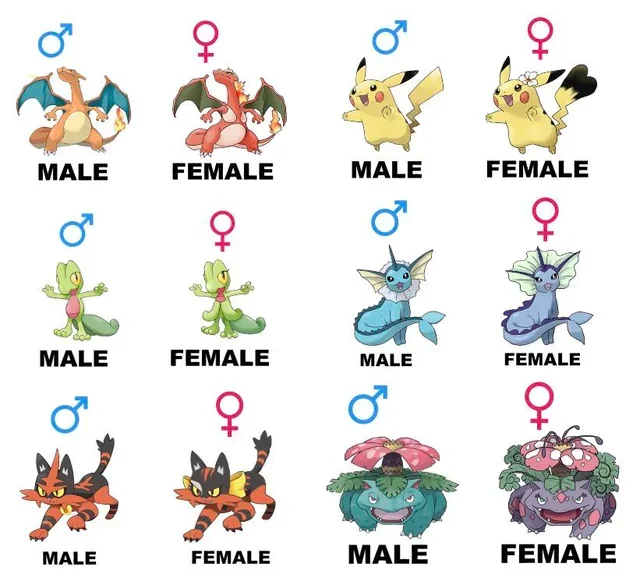
This is where my issues arise with certain edits of Pokémon people have done in the past. The above image is an infamous piece in the Pokémon community as an attempt to give some Pokémon without gender differences, gender differences. While the designs definitely are distinct from one another, that is actually an issue. The design philosophy of gender differences in the games follow rules based on the Pokémon. The biggest rule is that gender difference should be based on the type of Pokémon given the gender difference. What this means is that Pokémon like Scyther, a bug Pokémon, will have a bigger abdomen if it is female as opposed to its male counterpart. This aligns with how the real world bugs Scyther was based on appear.
If it was not apparent, the designs in the infamous gender difference Pokémon photo do not follow this rule. Instead, the designs follow gender stereotypes of masculine and feminine aesthetics of people, not animals. Giving a bow to Torracat, making Pikachu have a flower in its hair, and making Venusaur more pink, are just weird stereotypes that have nothing to do with the actual Pokémon itself. This type of design philosophy goes against a lot of game design knowledge as discussed in the book “A Theory of Fun for Game Design,” by Raph Koster. In this book Koster mentions how players of games will have pattern recognition and want to follow the logic presented to them. Having a glaringly different approach to the design philosophy of Pokemon will break the immersion with the player and cause confusion. While I am all for freedom of expression when it comes to fan made designs, I do wish that the designs were closer to how they may actually look in the games.
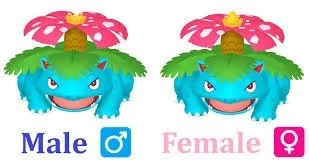
To better illustrate this point, here is an example of the Pokémon Venusaur that the photo depicted with a male and female version. In the games, there is actually an official design difference of Venusaur, this being that female Venusaurs have a gynoecium while male Venusaurs do not. A gynoecium is a female reproductive part of a flower, and Venusaur clearly has a large flower on its back. This relates back to the origin of the Pokémon being a flower and gives a fun little nod to anyone who can notice the gynoecium. It is a subtle change and many people playing the game will not notice it unless someone points it out to them.
Perhaps this is just my personal opinion on the matter, but I am a big fan of these small changes because it makes the world of Pokémon feel more alive. In the book “The Art of Game Design: A Book of Lenses,” by Jesse Schell, this idea is discussed on player perception of the world around them. In the Pokémon universe, it is known that all animals have been replaced with Pokémon, some Pokémon resembling their animal counterparts. Just as animals in real life have differences between their genders, so do Pokémon. It feels to me I am not alone in this because of the infamous photo, while I dislike how the Pokémon gender differences were drawn, there was still an effort made to see this be a reality, which I have to respect. There are of course Pokémon with not so subtle gender differences, but those differences are still based on their respective origin, such as Hippopatas having different colors based on their gender. This is much more of an opinionated blog than a single truth, I know that some like the heavily changed gender differences of Pokémon, and that is fine to do. However, for myself, I quite like the subtlety and origins of these differences which helps make the world of Pokémon feel more alive.
